Building Enterprise AI Agents: From LLM Conversations to Real Business Actions
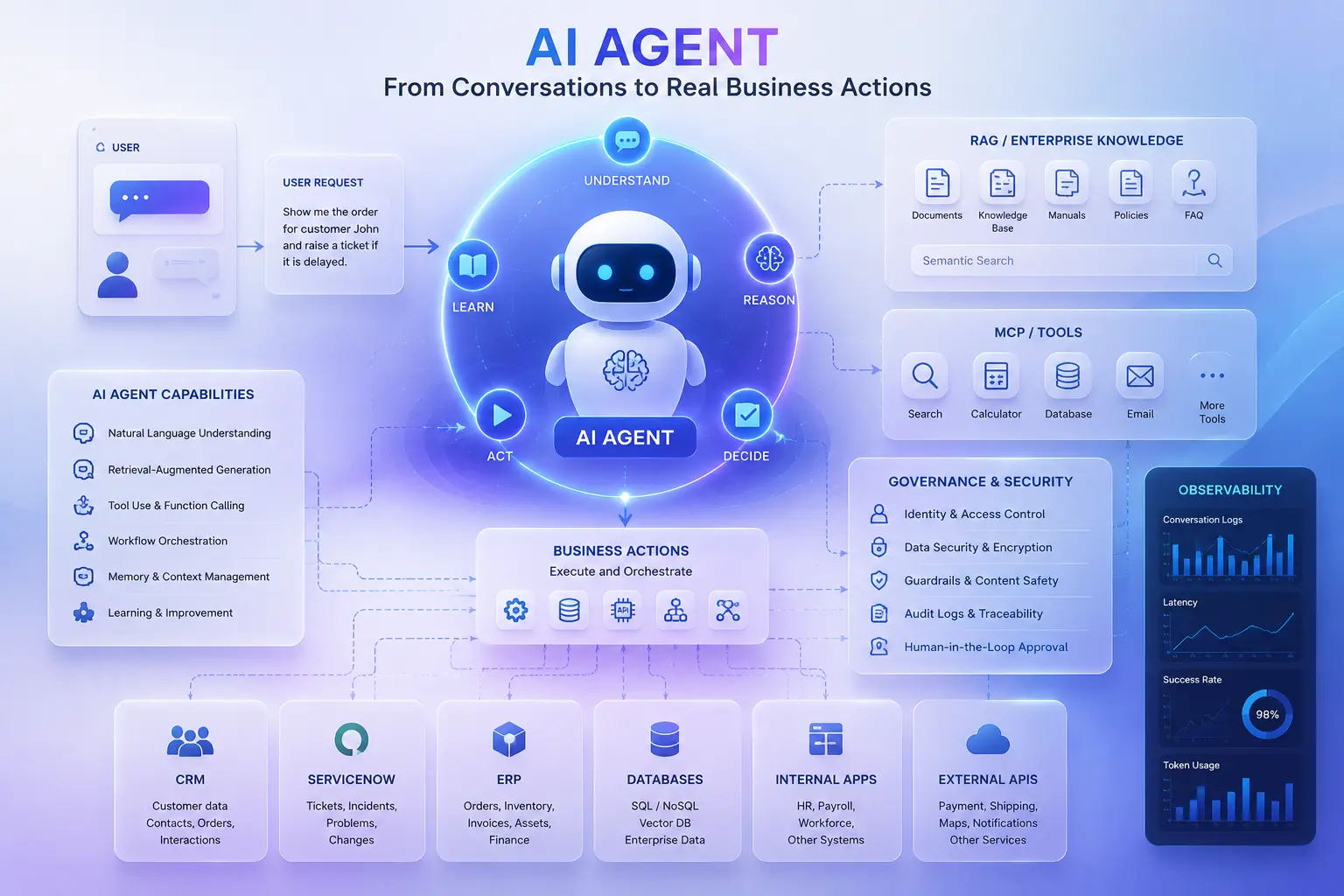
The progression that matters is moving from a normal chatbot that answers questions to an agent that can understand → reason → retrieve → use tools → execute → report results. That shift, from generating an answer to taking a verified action inside real business systems, is grounded in actual solution-building experience rather than a generic explanation of what an AI agent is.
From Understanding to Executing
A normal chatbot answers a question and stops there. An enterprise AI agent goes further: it has to understand the request, reason about what's actually being asked, retrieve relevant context, use tools to check or change real systems, execute the action, and report the results back. Each of those steps — understand → reason → retrieve → use tools → execute → report results — is a real engineering component, not a single prompt.
A Support Ticket, Start to Finish
A practical enterprise example makes the progression concrete: a support ticket arrives, the agent understands the issue, retrieves relevant knowledge through RAG, checks systems through tools and APIs, determines the appropriate team, creates or assigns the ticket, and records what it did. Every layer of the architecture shows up in that one workflow — reasoning, retrieval, tool use, and reporting — in a way a question-answering chatbot never has to exercise.
The Architecture: LLM, RAG, MCP/Tools, and Enterprise APIs
Put together, the architecture is LLM + Agent Orchestration + RAG + MCP/Tools + Enterprise APIs + Identity/Security + Observability + Human Approval. The LLM reasons; the orchestration layer manages the plan-act-observe cycle; RAG grounds the agent in enterprise knowledge rather than general training data; and MCP or a tool-calling layer connects the agent to real business systems — CRM, ServiceNow, ERP, databases, and internal applications — as callable actions rather than open-ended access.
What Separates a Real Enterprise Agent from a Demo
The production concerns that distinguish a real enterprise agent from a demo are authorization, tool permissions, grounding, hallucination control, audit trails, human-in-the-loop approval, cost, latency, and observability. A demo can skip every one of these and still look impressive in a walkthrough; an agent that's actually allowed to touch a CRM or ERP in production cannot.
What We Build
We build AI agents that connect enterprise knowledge with real business systems — enabling AI to move beyond answering questions and safely execute business workflows.
Want to talk through this for your organization?
We help teams plan and deliver work like this. Request a consultation and we'll talk through your specific situation.
Request Consultation